

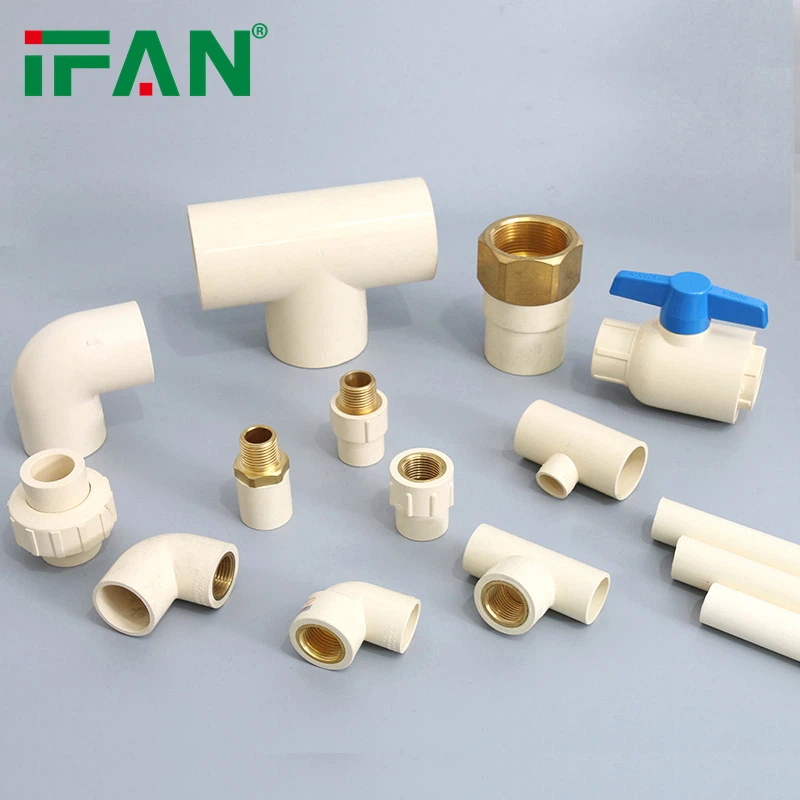


IFAN CPVC Beige Fittings
CPVC (Chlorinated Polyvinyl Chloride) pipe fittings are high-performance plastic fittings used in piping systems. They are made from chlorinated polyvinyl chloride material and possess excellent resistance to chemical corrosion and heat, commonly used in hot water systems, chemical processing pipelines, and industrial applications.

Product Attributes Table:
| Attribute | Description |
|---|---|
| Material | Chlorinated Polyvinyl Chloride (CPVC) |
| Heat Resistance | Maintains stability under high temperatures |
| Size | 1/2"-2" |
| Installation Method | Clamp or glue connection |
| Applications | Hot water systems, chemical processing pipelines, industrial applications |
| Working Presure | PN10 |
Advantages:
Chemical Resistance: CPVC pipe fittings can resist corrosion from various chemicals, suitable for a variety of chemical processing pipelines.
Heat Resistance: CPVC pipe fittings can withstand high-temperature water flow without deformation or breakage, suitable for hot water systems and industrial applications.
Easy Installation: CPVC pipe fittings are typically connected using clamps or glue, making installation simple and requiring no specialized welding tools.
Lightweight: CPVC pipe fittings are lighter compared to metal fittings, making them easy to transport and install.
Environmentally Friendly: CPVC material is recyclable, making it environmentally friendly.
Disadvantages:
Higher Cost: CPVC pipe fittings are more expensive compared to standard PVC fittings.
Temperature Limitations: While CPVC has high heat resistance, it may still deform or break under extreme high-temperature conditions.

Applications:
Hot Water Systems: CPVC pipe fittings are commonly used in residential and commercial building hot water piping systems due to their excellent heat resistance.
Chemical Processing Pipelines: Because of their good resistance to chemical corrosion, CPVC pipe fittings are widely used in chemical plants and laboratory chemical processing pipelines.
Industrial Applications: CPVC pipe fittings are also widely used in various industrial fluid conveying systems, including wastewater treatment, pharmaceuticals, and food processing.
Usage Steps:
Preparation: Ensure the connecting surfaces of the pipes and fittings are clean, smooth, and free from dirt and impurities.
Apply Glue: Use appropriate CPVC pipe glue and evenly apply a layer of glue to the connecting surfaces of the pipe and fitting.
Insert Connection: Insert the CPVC pipe into the socket of the fitting, ensuring the insertion depth meets specifications, typically with the pipe fully inserted into the fitting socket.
Secure Connection: Ensure the pipe and fitting are properly aligned, then apply pressure and hold until the glue dries and sets, completing the connection.
Through this introduction, you can better understand the characteristics, advantages, disadvantages, and usage methods of CPVC pipe fittings, thereby making better choices and applications for this piping system product.


