


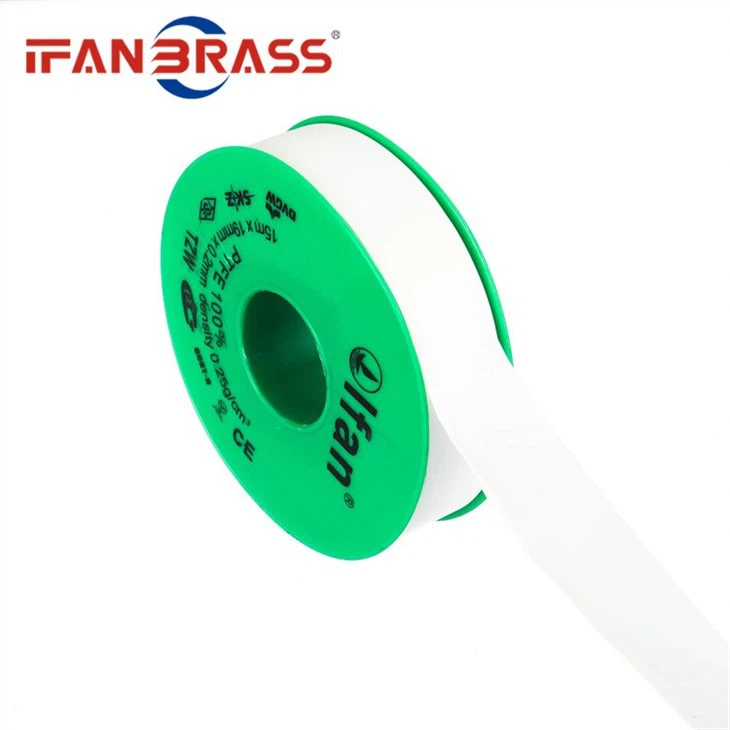
Product Information:
PTFE Plumbers Tape is a commonly used auxiliary product in the installation of liquid pipes. It is used at the connection of pipe fittings to enhance the airtightness of the pipe connection.
PTFE Plumbers Tape is a novel and ideal sealing material. Because of its non-toxic, odorless, excellent sealing, insulation, and corrosion resistance, it is widely used in water treatment, natural gas, chemical, plastic, electronic engineering and other fields.
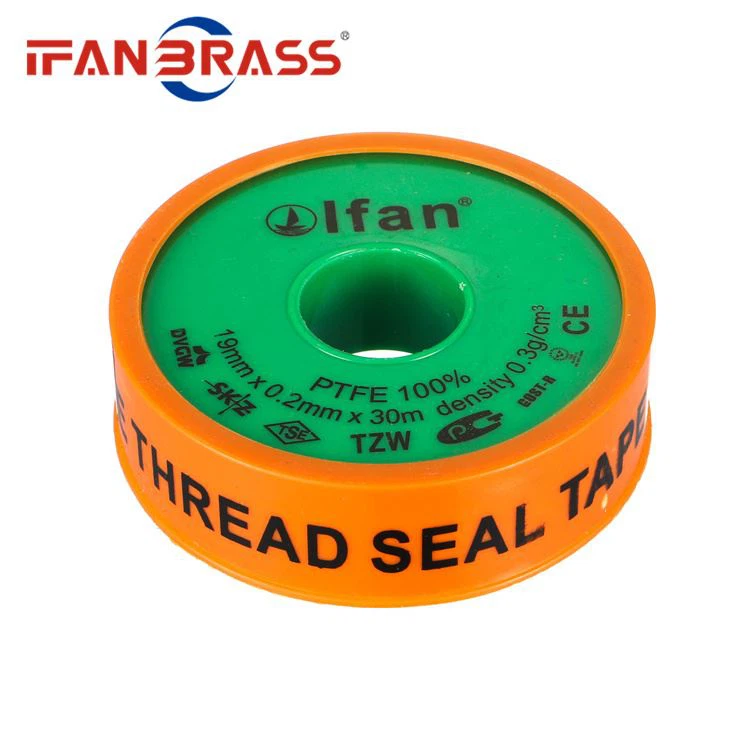
Product Size:
Size(mm) | PCs/Box | Weight(g) | CBM |
10M | 1000 | 13.2 | 0.089 |
15M | 500 | 40 | 0.100 |
25m | 500 | 47 | 0.100 |
30M | 500 | 56.5 | 0.100 |

Product Features:
The chemical name of the raw material belt is PTFE. Common white PTFE belts are commonly used in HVAC and water supply and drainage. There are also special PTFE belts for natural gas pipelines. In fact, the main raw materials are PTFE. It's just that some processes are different.
The raw material belt is produced with high-quality materials and advanced technology, with good quality and complete specifications, which can meet the requirements of different customers in different industries. The product has extremely superior insulation, extremely strong chemical stability and good sealing performance. It is widely used in machinery, chemical industry, metallurgy, electric power, shipbuilding, aerospace, medicine, electronics and other industrial fields.
The relative molecular mass of polytetrafluoroethylene is relatively large, the low is hundreds of thousands, the high is more than 10 million, generally several million (the degree of polymerization is on the order of 104, while that of polyethylene is only 103). Generally, the crystallinity is 90-95%, and the melting temperature is 327-342°C. The CF2 units in the polytetrafluoroethylene molecule are arranged in a zigzag shape. Since the radius of the fluorine atom is slightly larger than that of hydrogen, the adjacent CF2 units cannot be completely cross-oriented in trans, but form a helical twisted chain, almost covered by the fluorine atom. The surface of the entire polymer chain. This molecular structure explains the various properties of polytetrafluoroethylene. When the temperature is lower than 19°C, a 13/6 helix is formed; at 19°C, a phase change occurs, and the molecules are slightly unwound to form a 15/7 helix.
Although the rupture of carbon-carbon bonds and carbon-fluorine bonds in perfluorocarbons requires energy absorption of 346.94 and 484.88kJ/mol, respectively, the depolymerization of polytetrafluoroethylene to produce 1 mol of tetrafluoroethylene only requires energy of 171.38kJ. Therefore, during high temperature cracking, polytetrafluoroethylene is mainly depolymerized into tetrafluoroethylene. The weight loss rate (%) of PTFE at 260, 370 and 420℃ is 1×10⁻⁴, 4×10⁻³ and 9×10⁻² per hour, respectively. It can be seen that PTFE can be used for a long time at 260°C. As the highly toxic by-products such as fluorophosgene and perfluoroisobutylene are produced during high-temperature cracking, special attention must be paid to safety protection and to prevent PTFE from contacting open flames.