1. The Physics of Thermal Expansion
All solid materials expand when heated and contract when cooled. Brass is no exception to this rule. Its atoms vibrate more vigorously as temperature rises. This increased motion pushes the atoms slightly apart. The fitting physically grows in all dimensions. When the temperature drops, the process reverses.
2. The Expansion Coefficient of Brass
The rate of expansion is defined by a material constant. Brass has a linear thermal expansion coefficient of approximately 19 x 10⁻⁶ per degree Celsius . This means a 1-meter long brass pipe fitting will expand by about 0.019 mm for each 1°C increase. Over a 50°C temperature swing, this equals roughly 1 mm of dimensional change .
3. Comparison to Other Common Materials
Different materials expand at different rates. Carbon steel expands at about 11-12 x 10⁻⁶/°C . Copper expands at roughly 17 x 10⁻⁶/°C . Stainless steel (304/316) has a coefficient of 16-17 x 10⁻⁶/°C . Plastics expand much faster, with PVC at 54 and CPVC at 63 x 10⁻⁶/°C .
4. Stress at the Pipe-Fitting Interface
The fitting and the pipe are often different metals. This creates differential thermal expansion at the joint. A brass pipe fitting expands at a slightly different rate than a copper pipe . This difference generates shear stress at the connection point. Repeated heating cycles cause this stress to accumulate.
5. Effects on Threaded Connections
Threaded joints are the most vulnerable to temperature changes. The female threads expand slightly more than the male threads during heating, potentially loosening the grip . Over many heat cycles, threads can "walk" or develop fatigue, leading to loosening and eventually leaks.
6. Thermal Fatigue and Micro-Cracking
The real danger lies in repeated temperature cycles. Each cycle introduces microscopic stress at the fitting's most vulnerable points . Over time, these stresses accumulate into micro-cracks. The cracks grow with each additional cycle. This process is called thermal fatigue .
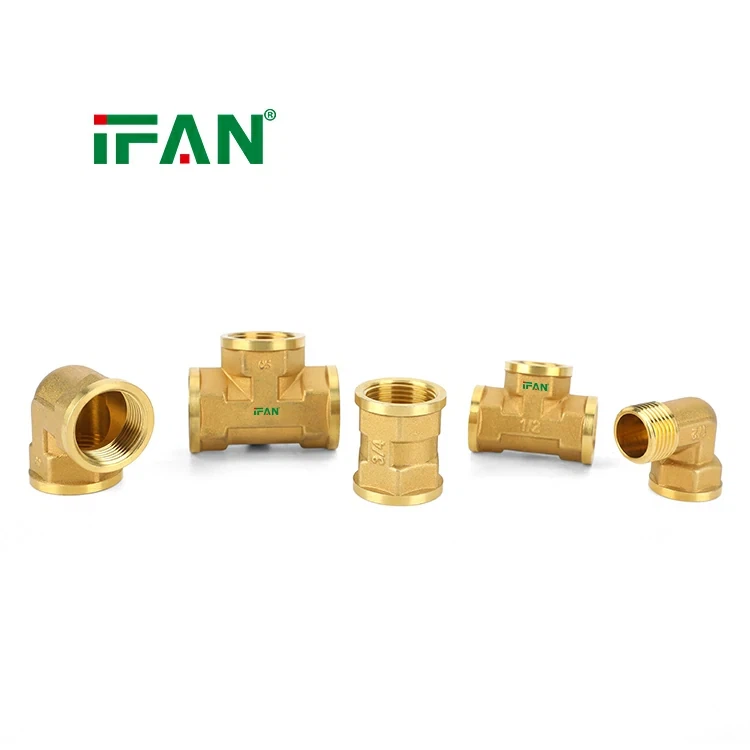
7. Impact on Elastomeric Seals and Joints
Temperature fluctuations directly degrade non-metallic sealing components. Rubber O-rings and gaskets may compress, harden, or lose elasticity over time . PTFE tape can also be affected by thermal cycling . As the brass pipe fitting expands and contracts, these materials may fail to maintain adequate sealing pressure.
8. Interaction of Heat and Pressure
As temperature rises, so does internal pressure in a closed system. Water expands significantly when heated. Higher temperatures reduce the strength of brass while simultaneously increasing system pressure . A brass pipe fitting rated for 150 psi at room temperature may handle only 100 psi at 200°F .
9. The 150°F Pressure Derating Rule
Industrial standards define specific temperature limits. For 125-pound brass fittings, the 200 psi liquid rating applies only when temperatures do not exceed 150°F . For 250-pound fittings, the 400 psi rating also requires staying below 150°F . Exceeding this temperature requires pressure derating.
10. Low-Temperature Performance Issues
Cold temperatures present different challenges. Brass can become brittle when very cold . Some brass pipe fittings have a minimum working temperature of -65°F (-54°C) . Other designs are rated down to -50°C . Below these thresholds, impact resistance drops significantly.
11. Differential Expansion in Mixed Systems
Mixed-material systems face additional stress. A brass pipe fitting connected to plastic pipe creates a major expansion mismatch . The plastic expands nearly three times more than the brass. This differential pulls and pushes on the connection. Without expansion loops or flexible connectors, joint failure is likely.
12. Managing Thermal Effects in System Design
Proper system design accommodates temperature-induced movement . Install expansion loops or U-bends in long pipe runs. Use flexible connectors where appropriate. Allow for movement in pipe supports. Choose high-quality forged brass pipe fittings over cast fittings for better fatigue resistance . Avoid over-tightening threaded joints. Apply appropriate thread sealant rated for thermal cycling. When correctly installed, brass fittings remain highly reliable across their rated temperature range.