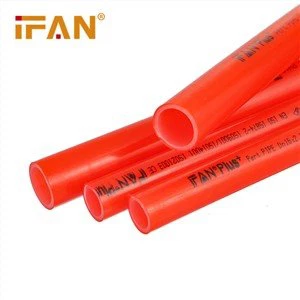


Product Information:
PEX A Tubing is called cross-linked polyethylene pipe. Its main purpose is to make floor heating pipes for water and floor heating. Of course, it can also be used for drinking water or solar pipes inside.
PEX A Tubing, PEX B Tubing, and PEX C Tubing are all cross-linked pipes, which are used for floor heating and radiator installation. The three types of pipes mainly have different cross-linking methods and different cross-linking degrees.

Product Size:
Size | M/Bag | Weight | CBM |
16×2.0 | 500 | 85 | 0.200 |
16×2.2 | 500 | 94 | 0.200 |
20×2.0 | 300 | 110 | 0.200 |
20×2.8 | 300 | 155 | 0.200 |
25×3.5 | 200 | 230 | 0.200 |
32×4.4 | 100 | 368 | 0.200 |

Product Features:
PEX A Tubing has good high and low temperature performance. The applicable temperature range is -20℃ to +95℃. The thermal conductivity is as high as 0.40W/mk. Toughness, excellent chemical resistance after cross-linking; two-dimensional network-based structure, which makes it more flexible and easy to bend and has low internal stress, which is convenient for heating coils; low-temperature notch impact strength and environmental stress crack resistance are excellent It has the same life span as the building; the unique memory ability enables it to recover to its original state when deformed by external stress, ensuring that it has a very reliable seal at the connection.

The working principle of the radiator:
The temperature of the radiator will not exceed the temperature of the hot water running in the water pipe below. Although it is a new technology, it must follow the principle of heat transfer and the law of conservation of energy: the temperature of the heated object will not be higher than the temperature of the heat source, otherwise the energy will no longer be conserved. The temperature of the radiator will at most reach the same temperature as the hot water in the pipe, and will not exceed the temperature of the hot water. In practice, the radiator needs to dissipate heat to the surrounding space, so it will not reach the temperature of the hot water in the water pipe below. Some buyers may have questions: How much lower the temperature of the radiator can be than the water? There are many random factors in this question, and it is difficult to determine. It has a lot to do with the room temperature, the size of the room, and whether it is tight and not easy to dissipate heat. If the room temperature is low, the room space is large, and the sealing is not easy to dissipate heat, a large amount of heat from the radiator will radiate to the surrounding space, causing the radiator to have a much lower temperature than water.