


Product Information:
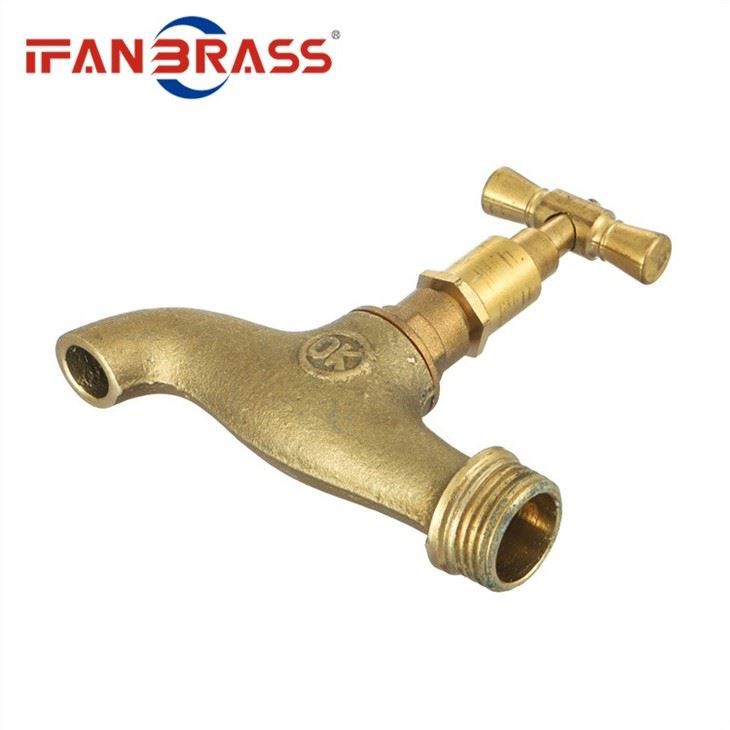
This Brass Bib Tap is one of the R series taps. The model is R06. The raw material is CW617 brass. It can be called Bibcock or Water Tap.
The biggest feature of this Brass Bib Tap is that it does not have an extended water outlet, and the faucet on it can be disassembled, that is, disassembly and assembly, which is very convenient for disassembly and assembly.
Product Size:
Size(mm) | PCs/Box | Weight(g) | CBM |
1/2"(15/21 in French) | 100 | 190 | 0.0180 |
3/4“(20/27 in French) | 120 | 235 | 0.0250 |

Product Features:
Faucets are one of the most commonly used sanitary products in home life, especially the faucets in the bathroom. The quality of the faucet is related to the quality of life. You can refer to the following points when purchasing:
1. Look at the coating
After the faucet is polished and formed, in order to prevent oxidation, a layer of nickel or chromium will be plated on its surface. Nickel or chromium has the function of anti-neutral hydrochloric acid, which can protect the faucet from corrosion for a long time. Place the faucet in a well-lit place, carefully check its surface for signs of oxidation, pores, leakage plating and burnt. The color is uniform, without burrs and grit. After pressing the faucet with your fingers, the fingerprints will quickly spread and there is no trace, and Good products are not easy to adhere to dirt.
2. Look at the material
The main body of the faucet is generally brass. The electroplating quality of the products made of brass is guaranteed. The higher the purity of the brass, the better the electroplating quality. The electroplated layer on the surface is less likely to be corroded. In order to reduce costs, some manufacturers choose zinc alloy instead of brass. Although the country allows the use of zinc alloy materials instead of brass, the quality of zinc alloy electroplating is poor and the corrosion resistance is not strong. Generally speaking, consumers can use the method of estimating the weight when purchasing. Brass is heavier and harder. , Zinc alloy is lighter and softer.
3. Look at the spool
The valve core of the faucet is usually a ceramic valve core, which is more heat-resistant and wear-resistant, and has good sealing performance. Therefore, the number of times of opening will be more resistant, and the faucet will not leak due to the wear of the valve core. It’s easy to judge whether the spool is good or bad. Generally speaking, consumers turn the handle up, down, left and right. If it feels light and without blocking, it means that the spool is better.
Installation Precautions:
If there is water dripping from the outlet of the faucet after installation, it is a problem with the spool. If it is installed, water is coming from the middle of the handle of the spool, not the quality of the spool itself, but the rubber at the bottom of the spool does not match the inside of the faucet.

General corrosion characteristics of brass:
Brass is a Cu-Zn alloy with Zn as the main alloying element. It is called brass because of its yellow color. According to the different types and contents of alloying elements added, brass can be divided into three categories: single-phase brass, complex-phase brass and special brass. When the zinc content is less than 36%, it constitutes a single-phase α solid solution, so single-phase brass is also called α brass. When the zinc content is 36%-45%, it becomes α + β complex phase brass. When the zinc content is greater than 45%, because there are too many β phases, it is brittle and has no practical value. Special brass is based on Cu-Zn, and added Sn, Mn, Al, Fe, Ni, Si, Pb and other elements.
Brass corrodes very slowly in the atmosphere, the corrosion rate is not large in pure fresh water (0.0025-0.025mm/year), and it corrodes slightly faster in seawater (0.0075-0.1mm/year). The fluoride in the water has little effect on the corrosion of brass, the chloride has a greater effect, and the iodide has a serious effect. In water containing O2, CO2, H2S, SO2, NH3 and other gases, the corrosion rate of brass increases dramatically. It is very easy to corrode in mineral water, especially water containing Fe2(SO4)3. Severe corrosion occurs in nitric acid and hydrochloric acid, slower corrosion in sulfuric acid, and corrosion resistance in NaOH solution. Brass has better impact corrosion resistance than pure copper.
The corrosion resistance of special brass is better than ordinary brass. Adding about 1% of Sn to brass can significantly reduce the dezincification corrosion of brass and improve the corrosion resistance in seawater; adding about 2% of Pb to brass can increase the wear resistance, thus greatly reducing The corrosion rate of it in flowing seawater. In order to prevent dezincification corrosion, a small amount of As, Sb, P (0.02%~0.05%) can be added; 0.5%~1.0% Mn is contained in navy brass, which can improve the strength and has good corrosion resistance. . In the brass containing 65% Cu and 55% Cu, 12%-18% Ni is used to replace part of Zn. Because the color is silvery white, it is called nickel silver or German silver. This alloy has excellent corrosion resistance in salt, alkali and non-oxidizing acid. At the same time, since a large amount of Ni has replaced 2n, there is no dezincification phenomenon.
Stress corrosion cracking of brass:
The factors affecting the stress corrosion cracking of brass are corrosive medium, stress, alloy composition and structure. A certain alloy will only corrode and crack under certain media and specific stress conditions.