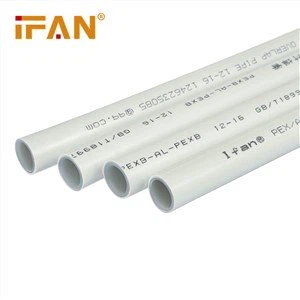


Product Information:
PEX B Pipe is a pipe mainly used for water supply piping system. Our product uses PEX, a soft and elastic material, which is highly flexible and easy to install. It has stable performance, reliable connectors, and very convenient connection and installation. It has a variety of specifications, and different specifications have different weights. Customers can refer to the table provided by us for selection.
Due to the choice of high-quality raw materials, our product has high corrosion resistance and scale resistance, and have a long service life. In addition, PEX B Pipe has excellent plasticity and easy bending and shaping characteristics, and its excellent high temperature and high pressure resistance further guarantees its use time.
Product Size:
Size | M/Bag | Weight | CBM |
16.2 x 2.6 | 100 | 135 | 0.052 |
20 x 2.9 | 100 | 185 | 0.920 |
25 x 3.7 | 100 | 290 | 0.106 |
32 x 4.7 | 100 | 462 | 0.106 |
40 x 6.0 | 100 | 734 | 0.106 |
Product Features:
PEX is made of soft and elastic material. Compared with PVC pipe, PEX is more resistant to cracking caused by freezing. Flexibility also makes PEX easy to install. PEX pipes can be bent around structural frames and other obstacles, thereby reducing the need for holes and notches to accommodate the pipes. The bend in the pipe also eliminates the need for many elbow transition fittings, thereby saving cost and installation time.
PEX saves energy by reducing heat transfer losses. In contrast, metal pipes are particularly prone to heat loss. PEX also does not corrode. Another advantage compared with metal pipes, especially galvanized steel pipes, is that galvanized steel pipes will continue to corrode over time. For amateur installers, perhaps the biggest advantage of PEX is that it does not require solder connections. PEX also requires fewer connections and accessories overall, which helps reduce costs and reduce leakage problems. Generally, PEX is installed faster than any other water supply pipeline.
The standard method of installing PEX pipe is to connect it with a barbed fitting and a special metal crimping ring fixed with a crimping tool. After crimping the ring in place, the installer uses inspection tools to check to confirm the diameter specification of the crimping ring.