


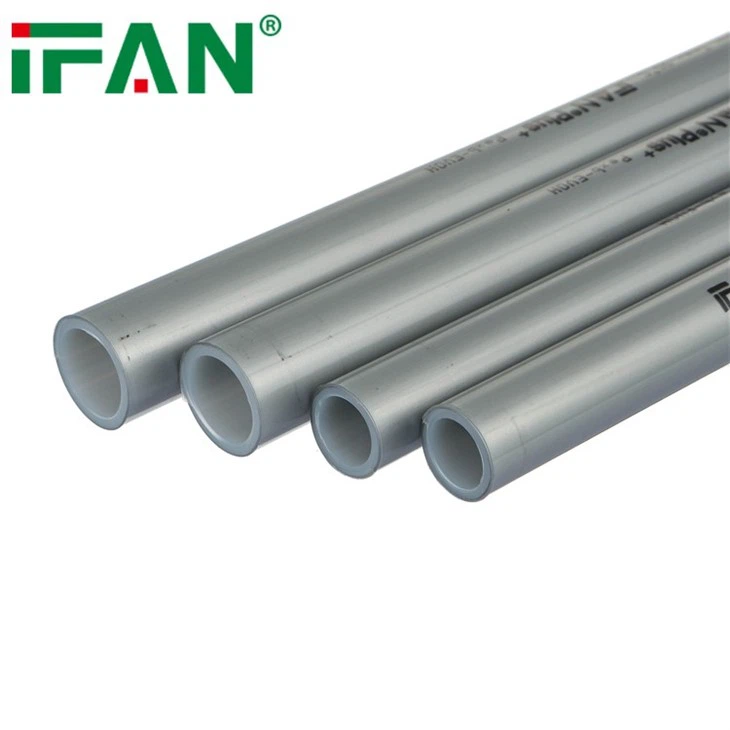
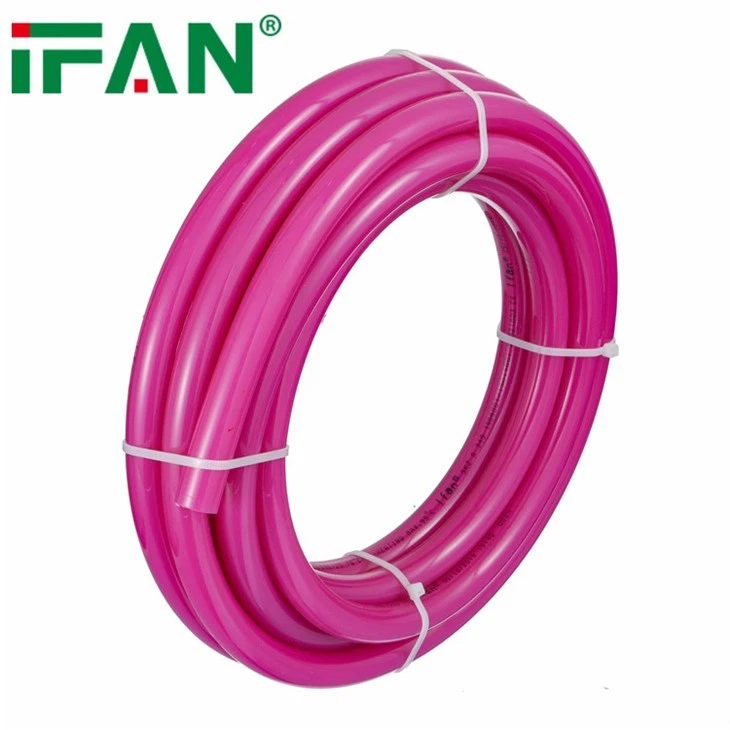

The raw material for the floor heating tube is a medium-density polyethylene with very stable mechanical properties, which is formed by metallocene-catalyzed copolymerization of monomers of ethylene and octene. Its unique ethylene backbone and short octene branched chain structure give it superior toughness, stress crack resistance, low-temperature impact resistance, temperature, excellent long-term water pressure resistance, and resistance to thermal creep of ethylene octene.
Click here for the product catalog and free sample.
| Name | Floor Heating Tube |
| Brand | IFAN |
| Size | 16-32mm |
| Package | 100M/Roll |
| Color | White, Yellow, Red, Purple |
| Support | OEM, ODM |

1. Softness: PE-RT is relatively soft. No special tools are required for construction, so the processing cost is relatively low.
2. Thermal conductivity: the pipes used for Underfloor heating must have good thermal conductivity. PE-RT has better thermal conductivity, and its thermal conductivity is twice that of PP-R and PP-B pipes. Ideal for use underfloor heating.
3. Low-temperature thermal shock resistance: PE–RT has better low-temperature impact resistance. During construction in winter, the pipes are not easily broken due to impact, which increases the flexibility of building arrangements.
4. Environmental protection: PE-RT and PP-R can be recycled without polluting the environment. However, PEX cannot be recycled and will cause secondary pollution.
5. Processing performance stability: PEX has problems such as controlling the crosslinking degree and crosslinking uniformity, and the processing is complicated and directly affects the performance of the pipe. However, PE-RT and PP-R are easy to process, and the performance of the pipe is basically determined by the raw material, and the performance is relatively stable.
PE-RT can be connected by the hot melt connection method and can be repaired by the hot melt connection of the pipe if it is accidentally damaged. raw materials for floor heating products have a creep failure curve that meets product standards and is the only polyethylene that can be used for hot water pipes without crosslinking at this stage.
Click here to contact us for more product information.
Floor heating pipe refers to a kind of pipe used as a low-temperature hot water circulation carrier in a low-temperature hot water ground radiant heating system (referred to as floor heating).
Since the birth of floor heating, there have been the following types of pipes used as floor heating pipes.
XPAPR: Cross-linked aluminum tube
PE-X: Crosslinked polyethylene 1
PAP: Aluminum-plastic composite pipe 2
PP-B: Impact-resistant copolymer polypropylene (once called PP-C in Korea)
PP-R: random copolymer polypropylene
PB: Polybutylene (ultra-high temperature resistant pipe)
PE-RT:: High-temperature resistant polyethylene
Note 1: Cross-linked polyethylene is divided into four types: peroxide crosslinking (PE-Xa), silane crosslinking (PE-Xb), electron beam crosslinking (PE-XC), and azo crosslinking (PE-Xd) according to the production method. Among them, peroxide crosslinking and silane crosslinking are two commonly used crosslinked polyethylene pipe products in China.
However, peroxide crosslinking is not widely used because of too fast oxygen permeation, silane crosslinking was banned in Europe in 2004 because of the toxic crosslinking agent silane, electron beam crosslinking (PE-XC) is a physical method to change the molecular structure, healthy and environmentally friendly pipe, azo crosslinking (PE-Xd) is in an experimental state.
Note 2: There are three kinds of aluminum-plastic composite pipes on the market, PE/AL/PE; PE/AL/XPE; XPE/AL/XPE. The first is that the inner and outer layers are polyethylene, the second is that the inner layer is cross-linked polyethylene, the outer layer is polyethylene, the third is that the inner and outer layers are cross-linked polyethylene, and the middle layer is an aluminum layer. The first type is generally used for cold water pipe systems, and the latter two are generally used for hot water pipes, which can be used as floor heating pipes.
According to the requirements of national and international product standards, the raw materials for the production of plastic pipes and plastic pipe fittings for cold and hot water must be in accordance with GB/T18252-2000 "Determination of long-term hydrostatic strength of thermoplastic pipes by extrapolation method for plastic pipe systems" and passed the qualification judgment. That is to say, each raw material manufacturer must make a creep failure curve that meets the reference curve of predicted strength according to the floor heating pipe product standard to prove that the raw materials sold are qualified. Only one point test of thermal stability under a hydrostatic state of 110 °C and 8760 hours can not prove whether the pipe raw material is qualified. If you don't know whether the raw material product is qualified, it is equivalent to cement not determining the label, and the use strength cannot be determined. Regardless of the kind of pipe used to lay floor heating, only the use of raw materials that meet the requirements of product standards, and the production equipment and process of reasonable and produced qualified pipes, through the correct design, installation, and use, can reliably ensure the service life of plastic pipes for floor radiant heating for fifty years.
PE-X
Domestic production generally adopts the method of crosslinking or peroxide crosslinking of medium-density polyethylene or high-density polyethylene with silane. It is to connect chemically between the linear long molecular chains of polyethylene to form a three-dimensional network molecular chain structure. Compared with general polyethylene, it improves tensile strength, heat resistance, aging resistance, stress crack resistance, and dimensional stability. The entire production process belongs to the chemical reaction process. This floor heating variety has cross-linking agent is not easy to disperse uniformly, crosslinking degree is difficult to control consistently, and need to clean the screw regularly to prevent the generation of gel particles and other difficulties, product quality control is difficult, general small production enterprises are difficult to do a good job. Qualified PE-X pipe has the advantages of good mechanical properties, high-temperature resistance, and low-temperature performance. However, PE-X pipes have no thermoplastic properties and cannot be connected and repaired by hot melt welding.
PB
Known as the soft gold in plastics, it has superior creep resistance and mechanical properties, is the softest of several floor heating pipes, and has the thinnest wall thickness under the same design pressure. Under the same conditions of use, the same wall thickness series of pipes, this variety of the highest safety to use. However, the price of raw materials is the highest, more than double that of other varieties, and the current application area in China is small. In the future, the market will slowly popularize this kind of pipe.
PE-RT
The floor-heating raw material is a medium-density polyethylene with very stable mechanical properties, which is formed by the catalytic copolymerization of ethylene and octene monomers by metallocene. Its unique ethylene backbone and octene short-branched chain structure make it have ethylene's superior toughness, stress crack resistance, low-temperature impact resistance, outstanding long-term water pressure resistance, and octene thermal creep resistance.
1. Flexibility: PE-RT is relatively soft. No special tools are required for construction, so the processing cost is relatively low. 2. Thermal conductivity: The pipe used for floor heating needs to have good thermal conductivity. The thermal conductivity of PE-RT is better, and its thermal conductivity is twice that of PP-R and pp-B pipes. Ideal for underfloor heating.
3. Low-temperature thermal shock resistance: PE--RT has good low-temperature impact resistance. During winter construction, the pipe is not easy to be broken by impact, which increases the flexibility of the construction arrangement.
4. Environmental protection: PE-RT and PP-R can be recycled and do not pollute the environment. PEX cannot be recycled and will cause secondary pollution;
5. Stability of processing performance: PEX has problems such as controlling the degree of crosslinking and crosslinking uniformity, and the processing is complex and the processing directly affects the performance of the pipe. PE-RT and PP-R are easy to process, and the performance of the pipe is basically determined by the raw material, and the performance is relatively stable.
PE-RT can be connected by a hot melt connection, and accidental damage can also be repaired with a pipe hot melt connection. Floor heating raw materials have a creep failure curve that meets product standards and is the only varieties of polyethylene that can be used for hot water pipes without crosslinking at this stage.
PE-RT II type pipeline mechanical properties
|
EP-RTII.型 Hydrostatic detection indicators |
Relevant standard requirements |
ISO22391 indicator requirements |
|||
|
Detection conditions |
Detection results |
Detection conditions |
Indicator requirements |
Detection conditions |
Indicator requirements |
|
20℃, 12.0MPa |
11.85h No leakage, Does not break |
20℃, 11.4MPa |
1 hour No leakage, Does not break |
20℃, 10.8MPa |
1 hour No leakage, Does not break |
|
95℃, 4.5MPa |
>1000h No leakage, Does not break |
95℃, 4.4MPa |
22 hour No leakage, Does not break |
9.5℃, 3.9MPa |
22 hour No leakage, Does not break |
|
95℃, 4.3MPa |
>1000h No leakage, Does not break |
95℃, 4.2MPa |
165 hour No leakage, Does not break |
95℃, 3.7MPa |
165 hour No leakage, Does not break |
|
95℃, 4.0MPa |
>1000h No leakage, Does not break |
95℃, 4.0MPa |
1000 hour No leakage, Does not break |
95℃, 3.6MPa |
1000 hour No leakage, Does not break |
|
Use condition levels |
Design Stress (Mpa) |
|
|
Poly PE-RT I TYPE |
Poly PE-RT II type |
|
|
60°C hot water system |
3.29 |
3.81 |
|
70°C hot water system |
2.68 |
3.54 |
|
Underfloor heating system |
3.25 |
3.84 |
|
Radiator heating system |
2.38 |
3.10 |
PE-XB
Clean, pollution-free, non-toxic, and tasteless, which can save people from the pain of drinking "yellow water" and "rusty water";
Temperature and pressure resistance, long-term use temperature up to 95 °C;
Anti-ultraviolet ray, anti-aging, service life up to long-term durability according to standards;
Easy to bend, simple and fast installation, few pipe fittings, economical and practical, the use of special pipe fittings, can be installed conveniently and quickly;
No need for tapping, buckles, welding;
Better resistance to environmental stress cracking.
Oxygen barrier tubes
In the early 20s of the 80th century, European and American technicians found that in the hot water circulation system using plastic pipes, the metal parts in the equipment were easy to corrode, resulting in rapid damage to the equipment. In 1982, experts concluded that when the pipe is heated, oxygen molecules are more likely to pass through the plastic layer and penetrate deep into the water inside the tube, resulting in rapid corrosion of the metal parts in the device. As a result, oxygen barrier tubes were developed.
In Europe and the United States, the utilization rate of oxygen barrier pipes in heating systems has reached 70%, and after nearly two decades of practical experience, the life of metal components in oxygen barrier pipe systems can be extended by 10-20 years.
Product Features
Oxygen barrier
To extend the service life of the system, EVOH blocks the penetration of oxygen into the water or air in the pipe, greatly extending the service life of metal valves, switches, boilers, manifolds, and other metal parts in the entire pipeline system.
Hygiene
Since it prevents the penetration of oxygen, which is necessary for the survival of microorganisms, the presence of microorganisms in the system is inhibited.
Oxygen barrier pipe also has the advantages of corrosion resistance, no scaling, small heat loss, energy saving and environmental protection, flexibility and easy bending, good hydrodynamic properties, and long life of other high-temperature resistant floor heating pipes.
Good pipe toughness, large bending radius, small construction strength, and convenient construction.
The pipe has good oxygen barrier performance, which can effectively delay the rust of the metal parts in the system, extend the service life of the metal parts, and reduce the scale of the pipeline system. Mainly used in various heating systems.
First, look at the surface of the floor heating pipe, the surface of the high-quality floor heating pipe is relatively smooth and not concave, with bubbles, obvious color differences, and impurities, and the floor heating pipe indicates the model, specification, and brand of the floor heating pipe. The printing on a good floor heating pipe is relatively clear and not easy to fall off.
Second, use your hand to feel whether the pipe has a groove, and the pipe with good quality feels delicate and smooth to the touch, and the degree of softness and hardness is moderate.
Third, compare the flexibility of the floor heating pipe with the wall thickness, the wall thickness of individual floor heating pipes is marked as 2.0, some floor heating pipes are marked with a wall thickness of 2.0, but the actual wall thickness can not be reached, but the wall thickness of good quality floor heating pipes can reach the request, and the same as the label. When you are helpless to identify the pipe alone, you may use two pipes to compare and see which pipe has a thicker wall.
Fourth, the detection part of the monitoring, to the detection part of the test is the method taken when the floor heating pipe is jealous, in some cases the floor heating pipe used by the floor heating company are qualified product, and there is a test report and quality assurance commitment, simple pipe quality testing methods may be carried out through the naked eye and feel, but the detection method of functional indicators can only be carried out in the laboratory.
1). Use staples to fix the heating tube directly to the insulation board or the insulation board with a composite surface layer (commonly used );
2). Use cable ties to fix the heating tube to the grid laid on the insulation layer;
3). Directly stuck on the special pipe rack or tube card laid on the surface of the insulation layer;


