

Product Information:
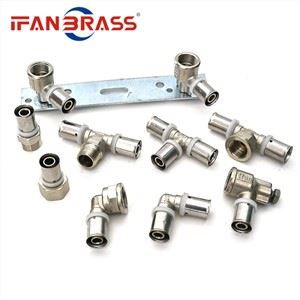
This PEX Al PEX Union is a compression fitting of IFAN, which is mainly used to connect PEX pipes. It has high durability and can be connected to PEX pipes at both ends. It meets the requirements of drinking water regulations and is very suitable for heating, sanitation and drinking water and other device usage conditions.
PEX Al PEX Union usually uses carton packaging, accepts packaging customization, and supports various transportation methods such as sea transportation.

Product Size:
Size×Thickness(mm) | PCS/Bag | Weight(g) | CTN SIZE |
16×1/2 | 220 | 56 | 0.011 |
18×1/2 | 200 | 58 | 0.011 |
20×1/2 | 180 | 70 | 0.011 |
20×3/4 | 180 | 96 | 0.011 |
25×3/4 | 140 | 120 | 0.011 |
32×1 | 100 | 240 | 0.011 |
Product Features:
Construction specifications of pressed stainless steel pipes: pressed thin-walled stainless steel pipes are increasingly used in direct drinking water systems, and the construction of pressed thin-walled stainless steel pipes is quite different from those commonly used in the past, which requires us to have professional construction. Specifications as guidance, master the construction points, and carry out standardized construction.

Advantages of press-type stainless steel pipes: Pipeline drinking water is tap water or raw water that meets drinking water standards. After deep purification, it is transported through pipelines to provide users with pure water for direct drinking. It has superior mechanical properties, reasonable price and convenient installation. The advantage has become a high-quality direct drinking water pipe, which has a broad prospect of use.
Compression principle: An O-shaped rubber sealing ring is installed in the annular U-shaped groove of the port of the stainless steel compression pipe fitting. When installing, insert the stainless steel water pipe into the port of the pipe fitting, and then use a special clamping tool to make the water pipe and pipe fitting socket ( DN15~~DN50 hexagonal clamping, DN65~~DN100 annular clamping) U-shaped groove convex part reduces the diameter, thereby compressing the sealing ring to ensure sufficient sealing performance and connection strength. In Europe, the extrusion connection technology was invented in the 1960s. The improved technology enables the thin-walled stainless steel pipe to be realized, and was introduced into China in the 1990s, and subsequently became an important thin-walled stainless steel connection method in China. At present, my country has customized a complete set of national standards (GB/T 19228 thin-walled stainless steel compression fittings).

Construction points: thin-walled stainless steel pipes and pipe fittings should not be in direct contact with cement slurry, cement, mortar and mixed concrete; pipe openings should be blocked in time after installation of pipes or after completion; When laying, holes and grooves should be reserved in accordance with civil engineering; reliable waterproof measures should be taken when the pipeline passes through the basement or the outer wall of the underground structure; the connection between the thin-walled stainless steel pipe and the valve, water meter, water nozzle, etc. should adopt the conversion joint. Do not thread the thin-walled stainless steel water pipe; the installed main pipe must not have obvious undulation, bending and other phenomena, and the outer wall of the pipe should be free of damage; the allowable deviation of the coordinates and elevation of the pipeline system should meet the regulations; The bending of the direction, the verticality of the riser, the allowable deviation of the parallel pipes and the rows of valves should meet the regulations; the drinking water pipes should be filled with 0.03% potassium permanganate disinfectant for disinfection after passing the pressure test. The disinfectant should be left standing in the pipeline for 24 hours, and then rinsed with drinking water after emptying. The water quality of drinking water should meet the requirements of the current national standard "Drinking Water Sanitation Standard"; pipes and fittings should be handled with care when loading, unloading, and handling, and avoid oil pollution, and should not be thrown, dropped, rolled, or dragged; Tie a safety rope, put on a handstand, use it as a support, etc.