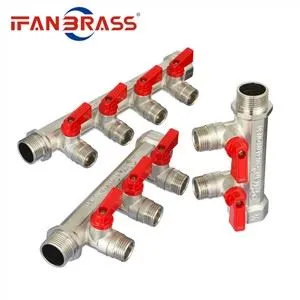


Product Information:
The Floor Heating Manifold is mainly used for flow distribution and adjustment of floor heating or refrigeration systems. It is a commonly used accessory in households, and it is also an indispensable accessory. Floor Heating Manifold plays an indispensable role in the regulation of water flow.
How to repair the leaking of the floor heating pipe?
First, find out the location of the floor heating pipe leaking and clean the tile cement on it. You can use the local repair method, that is, only repair the floor heating pipe at the leaking location, first cut all the leaking floor heating pipes, and then replace them with new ones. For floor heating pipes, it is recommended to use welding or electric welding to connect with other floor heating pipes to ensure that no water leaks at the joints. Finally, they can be used after sealing with cement and ceramic tiles. If the leakage area is large, it is recommended to replace the floor heating pipes. Although the amount of work will be large, it will reduce a lot of troubles.

Features of Floor Heating Manifold, Water Collector and Water Sub-catchment
The water manifold is a water flow distribution and gathering device composed of a water collector and a water separator. The water separator is a device that disperses the water in one channel into several outputs, and the water collector is a device that collects the water from multiple channels into one output. It is different from other products in air conditioning systems such as heat exchangers, vacuum deaerators, etc. The manifold is mainly used in waterway systems. Various distributors and water collectors can be customized according to customer needs.
The structure is composed of main pipes, branch pipes, sewage outlets, exhaust outlets, pressure gauges, thermometers, etc. The cylinder with a larger diameter is equipped with a manhole or hand hole. The material is made of rolled carbon steel plate or made of seamless steel pipe, which can withstand a certain pressure. It belongs to the professional manufacturing of pressure vessels, and the outer surface is treated with anti-corrosion or heat preservation.
The cylinder of the water manifold is connected with multiple water inlet and outlet pipes as needed, which can collect water from various channels or flow water from one channel. The cylinder is equipped with a pressure gauge or a thermometer to facilitate the observation of the water flow in the cylinder. The lower end of the cylinder is equipped with a sewage outlet for the sewage to flow out when the cylinder is cleaned. On the one hand, it distributes the water in the main pipe according to the needs to ensure that the flow of the branch loops in each area meets the load needs. At the same time, it also collects the water flow of each branch loop and inputs it into the main return water pipe to achieve cyclic operation. Its return water reuse can achieve more energy-saving effects, and can meet the needs of heating and cooling at the same time. It is widely used in boilers, central air conditioning, industrial circulating cooling water systems, and hot water systems.
Installation requirements for floor heating manifolds:
The water separator is installed in the wall and special box, and the house is generally installed in the kitchen; the valve under the water collector is installed horizontally at a distance of 30 cm or more from the floor; the water supply valve is installed in front of the water separator, and the return valve is installed in the water collector Back; the filter is installed in front of the water separator.
Why is the floor heating manifold not suitable to be installed in the bathroom?
There are mainly the following reasons, which are for reference only.
1. There are many pipelines below the floor of the toilet, and there is still space for draining floor drains and toilets. If the water divider is set here, the pipes will be dense because of the concentration, and they will definitely cross other pipelines.
2. The space of the bathroom is relatively small. If the manifold is installed in the bathroom, it will be troublesome to repair if there are problems in the future.
3. The toilet uses a lot of water, which may cause safety hazards in the long run.